
What is the tragedy of the commons? Hardin’s idea, real examples from cod to CO2, Elinor Ostrom’s 8 design principles, and solutions that work.
National Councils for Sustainable Development
Solarpunk: The Hopeful Vision of a Sustainable Future
What Is Ecotourism? Principles, Examples, Greenwashing
What is ecotourism? Learn its 8 core principles, real examples from Costa Rica to Palau, its downsides, and how to spot greenwashing before you book.
The Phosphorus Cycle: Steps, Human Impact and Why It Matters
Learn how the phosphorus cycle moves through rocks, soil, water, and life—and how fertilizer runoff can disrupt ecosystems.
Anthropogenic: Meaning, Examples and Effects on the Planet
Learn what anthropogenic means, how human activities affect climate and wetlands, and why the term matters for understanding planetary change.
Agenda 21, Chapter 18: protecting freshwater resources
Chapter 18 of Agenda 21 set out the first global programme for freshwater management. Here is what it asked for and how the water agenda looks today.
Regional sustainable development networks: Africa, Asia-Pacific, the Americas and Europe
Sustainable development work is organised by region as much as by country. An overview of the regional bodies and where their reports can be found today.
National Councils for Sustainable Development: what they were and what replaced them
How the national councils that grew out of the 1992 Earth Summit worked, why the global network faded, and where that work continues today.
WSSD – World Summit for Sustainable Development
The World Summit for Sustainable Development (WSSD) refers to a summit that occurred in Johannesburg in the last week of August and first week of September 2002. It
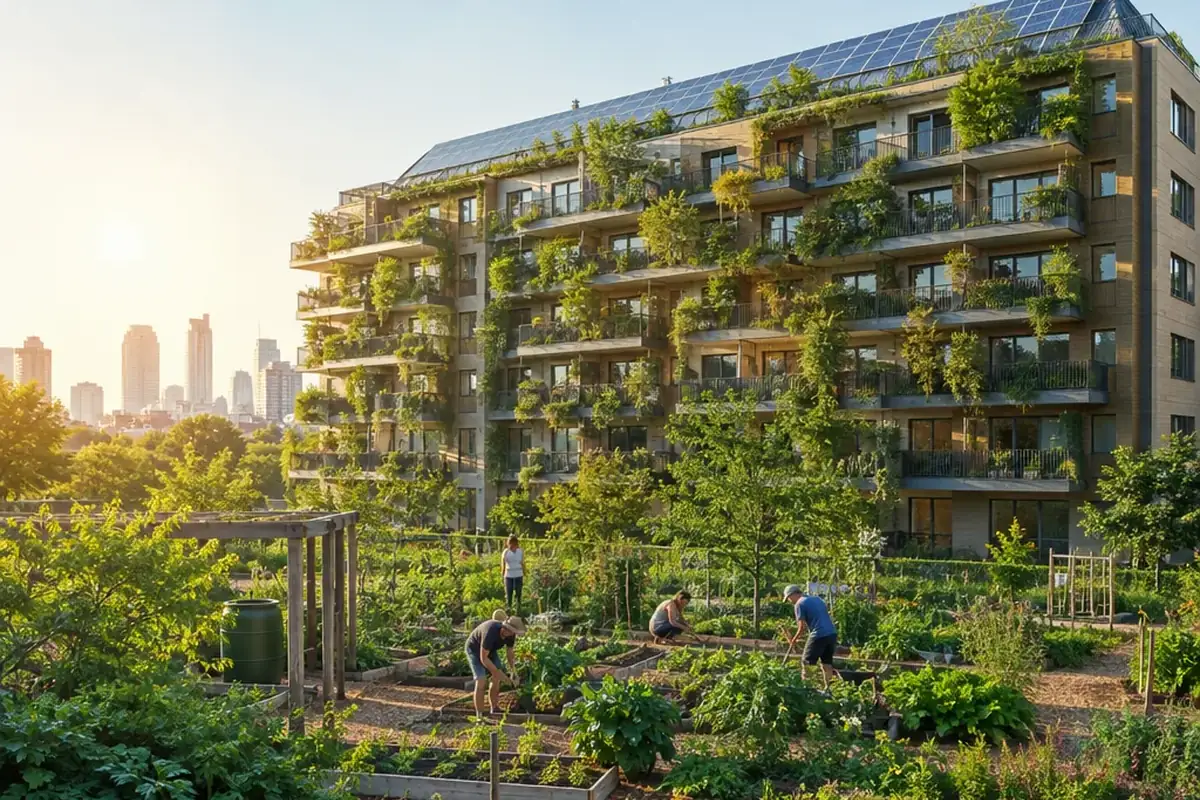
Solarpunk is a movement in speculative fiction, art, fashion, and activism built around one question: what does a sustainable civilization look like, and how can we get there? Dystopias often end in collapse. Solarpunk often starts after the disaster and shows the rebuilding: rooftop solar, buildings covered in plants, repair cafes, and neighbors who share tools. The name comes from a roughly 300-word blog post from 2008. Today the idea covers novels, a survival game on Steam, an eco-village in the Netherlands, and two towers in Milan that carry more than 900 trees.
What Is Solarpunk? A Short History of the Idea
The word first appeared on May 27, 2008, in “From Steampunk to Solarpunk,” a post by John Robert on the blog Republic of the Bees. One ship inspired it: the MS Beluga Skysails, a cargo vessel pulled by a computer-controlled kite. The post imagined an economy powered by renewable energy, where sailing ships carry freight again.
The idea grew in 2014. On August 2, artist Olivia Louise posted illustrations on Tumblr of green cities, stained glass, and nature-inspired fashion, and those images set the look of the genre. That September, Adam Flynn published “Solarpunk: Notes toward a Manifesto” on Arizona State University’s Hieroglyph project. It named four principles: ingenuity, generativity, independence, and community. In 2019, “A Solarpunk Manifesto” built on Flynn’s notes and community input in 22 points. One of them reads: “optimism has been taken away from us and we are trying to take it back.”
The name works in two parts. “Solar” stands for solar energy and optimism. “Punk” stands for DIY, counterculture, post-capitalism, and decolonialism. Writers have named earlier forerunners, such as Norman Spinrad’s 1976 novel Songs from the Stars and the Talking Heads song “(Nothing But) Flowers” (1988), in which nature takes back a fast-food restaurant.
The Main Ideas and Goals of the Solarpunk Movement
- Decentralization: local energy grids, peer-to-peer networks, and decentralized social media in place of central platforms.
- Repairable technology: tools that can be fixed, reused, and kept for a long time, as opposed to black-box devices and planned obsolescence.
- Prefigurative politics: practicing the principles now, in eco-villages and community gardens, instead of only demanding change.
- Radical hope: rejecting climate doomerism and environmental pessimism.
- Inclusion: a future for all cultures, religions, abilities, genders, and sexual identities.
- Anti-consumerism: rejecting capitalism, consumerism, and eco-fascism. Rhys Williams summed it up as “against a shitty future.”
The manifesto puts the practical side this way: “Imagine ‘smart cities’ being junked in favor of smart citizenry.” In this view, building sustainable infrastructure is itself a political act.
Solarpunk vs. Cyberpunk: High Tech, Good Life
Solarpunk is often described as the inverse of cyberpunk, or as a “rebellion against a rebellion, born out of dystopia.”
| Aspect | Cyberpunk | Solarpunk |
|---|---|---|
| Motto | High tech, low life | High tech, good life |
| Mood and palette | Dark, neon, shadows | Bright greens, blues, earth tones, sunlight |
| Role of technology | Cuts people off from their environment | Helps people live alongside nature |
| Typical hero | Pushed aside by fast technological change | A “maker-hero” who has seen disaster and builds fixes |
| Power | Corporations | Cooperative, post-capitalist communities |
In some ways solarpunk is closer to steampunk: both imagine new worlds built around a main energy source, steam in one case and sunlight in the other. The manifesto separates itself from both, though. Its futurism is “not nihilistic” and “avoids steampunk’s potentially quasi-reactionary tendencies.”
The Aesthetics of Solarpunk in Architecture and Design
The visual style combines Art Nouveau, Hayao Miyazaki’s films (Nausicaä of the Valley of the Wind, 1984; Castle in the Sky, 1986), jugaad, the improvised innovation tradition from outside the West, and creative reuse of old infrastructure. Technology is put on display, not hidden: stained-glass solar panels show up again and again. Buildings are wrapped in plants, show their energy sources, and stay at a human, community-friendly scale. Belgian architect Luc Schuiten, born in 1944, has worked on “Archiborescence,” architecture modeled on trees, since the 1970s.
Real buildings show what the style can do:
- Bosco Verticale, Milan (2014): two towers, 110 m and 76 m tall, with more than 900 trees and 90 plant species. Together the trees equal about 20,000 square meters of forest.
- One Central Park, Sydney (2014): botanist Patrick Blanc covered half the facade with more than 35,000 plants. The building uses 25% less energy.
- Oasia Hotel Downtown, Singapore: 27 stories covered in more than 21 plant species.
The benefits can be measured. Green facades can cut heating and cooling needs by up to 30%. Green spaces can lower local temperatures by up to 2°C (3.6°F), and noise near vertical gardens drops by 5–10 decibels.
Solarpunk Stories, Screens, and Games
Becky Chambers’ Monk & Robot books, A Psalm for the Wild-Built (2021) and A Prayer for the Crown-Shy (2022), are the go-to examples of solarpunk fiction. Other key titles include Kim Stanley Robinson’s The Ministry for the Future (2020), Ruthanna Emrys’ A Half-Built Garden (2022), set by the Chesapeake Bay, and the forerunner The Dispossessed (1974) by Ursula K. Le Guin. Sarena Ulibarri’s anthologies Glass and Gardens: Solarpunk Summers (2018) and Solarpunk Winters (2020) collect short solarpunk stories.
On screen, Black Panther‘s Wakanda pairs vertical gardens with clean energy. Netflix’s Arcane shows community gardens and mutual aid in its undercity, Zaun. There is also a role-playing game, Fully Automated! (2022), and a 2024 open-world survival game called Solarpunk that combines ecology with base building. Player reviews on Steam point to technical problems.
How Realistic Is a Solarpunk Future?
The technology already exists. Solar power got more than 90% cheaper between 2010 and 2024, and the International Energy Agency has called it the cheapest source of electricity in many regions. Working examples:
- Aardehuizen, Olst (Netherlands): 23 homes for about 70 residents, with 274 solar panels, compost toilets, and reed-bed water treatment. About 40 residents and 1,500 volunteers from 27 countries built it between 2011 and 2015, for about €5 million.
- Vauban, Freiburg (Germany): most homes make their own solar power, and some “plus-energy” buildings feed extra power into the grid.
- Tengeh Floating Solar Farm, Singapore: 45 hectares and more than 122,000 panels, supplying about 12,500 households.
- Nanjing Green Towers (China): more than 1,100 trees and 2,500 shrubs, which absorb about 25 tons of CO2 a year.
The obstacles are mainly political and structural. From 2015 to 2018, Spain charged a 7% levy on private solar systems. Eco-villages are hard to scale up to whole cities. AEI commentator James Pethokoukis argues that old systems don’t simply disappear, a problem known as path dependence.
Criticisms and Common Myths
Critics call solarpunk vague, with “no substance beyond the naive phrase ‘a better world is possible.'” Others point to greenwashing, such as Chobani’s 2022 “Dear Alice” ad. Some say the fiction ignores Indigenous voices despite its decolonial goals, romanticizes farm life, or uses AI-generated images that consume huge amounts of energy.
- Myth: “It’s just a look.” Jay Springett: “If your rendering of a future has no people in it, it’s not solarpunk.”
- Myth: “Any green tower counts.” Building the Bosco Verticale cost about €1,950 per square meter, but apartments have sold for up to €18,100 per square meter. Springett calls luxury green condos that push out longtime residents “fake solarpunk urbanism.”
- Myth: “It means rejecting technology.” The goal is technology that is repairable and decentralized, not no technology at all.
- Myth: “It’s pure fantasy.” The manifesto describes it as “a set of achievable proposals,” and Aardehuizen already exists.
How You Can Help Build a Solarpunk Future
- Plant a shade tree to reduce air-conditioning needs.
- Use or start a repair cafe or tool library.
- Set up a seed library. During Solarpunk Action Week, people in the UK turned a phone booth into one.
- Organize a “permablitz”: in a single day, a group turns an unused lot into a productive garden.
- Talk with gardeners in your neighborhood and share what you learn.
- Push for system-wide changes: carbon pricing, ending fossil fuel subsidies, and better public transit.
As Springett puts it, “LARPing solarpunk is going out and planting a garden.”
Frequently Asked Questions
Is Zootopia solarpunk?
It looks the part, with green roofs, vertical gardens, and wind turbines, and the same goes for Big Hero 6‘s San Fransokyo. But the story centers on prejudice and class conflict, and the city’s power structure doesn’t reflect solarpunk values. That’s why TV Tropes calls it a subversion of the genre.
Does solarpunk have an ending?
No. The genre has no fixed ending. Its stories often begin after a catastrophe and focus on building or defending a better world. The manifesto describes solarpunk as a process, “a way of living” toward a goal, not a finished state.
How much will Solarpunk be?
If you mean the 2024 survival game, prices change with sales and region, so check its current Steam listing. The movement itself costs nothing to join: a seed swap or a repair cafe visit is a full solarpunk act.
Sustainable development meets the needs of the present without compromising the ability of future generations to meet their own.