
What is the tragedy of the commons? Hardin’s idea, real examples from cod to CO2, Elinor Ostrom’s 8 design principles, and solutions that work.
National Councils for Sustainable Development
Anthropogenic: Meaning, Examples and Effects on the Planet
What Is Ecotourism? Principles, Examples, Greenwashing
What is ecotourism? Learn its 8 core principles, real examples from Costa Rica to Palau, its downsides, and how to spot greenwashing before you book.
Solarpunk: The Hopeful Vision of a Sustainable Future
What is solarpunk? Origins, core ideas, architecture, solarpunk vs. cyberpunk, real-world projects, criticisms, and how you can help build it.
The Phosphorus Cycle: Steps, Human Impact and Why It Matters
Learn how the phosphorus cycle moves through rocks, soil, water, and life—and how fertilizer runoff can disrupt ecosystems.
Regional sustainable development networks: Africa, Asia-Pacific, the Americas and Europe
Sustainable development work is organised by region as much as by country. An overview of the regional bodies and where their reports can be found today.
National Councils for Sustainable Development: what they were and what replaced them
How the national councils that grew out of the 1992 Earth Summit worked, why the global network faded, and where that work continues today.
Agenda 21, Chapter 18: protecting freshwater resources
Chapter 18 of Agenda 21 set out the first global programme for freshwater management. Here is what it asked for and how the water agenda looks today.
WSSD – World Summit for Sustainable Development
The World Summit for Sustainable Development (WSSD) refers to a summit that occurred in Johannesburg in the last week of August and first week of September 2002. It
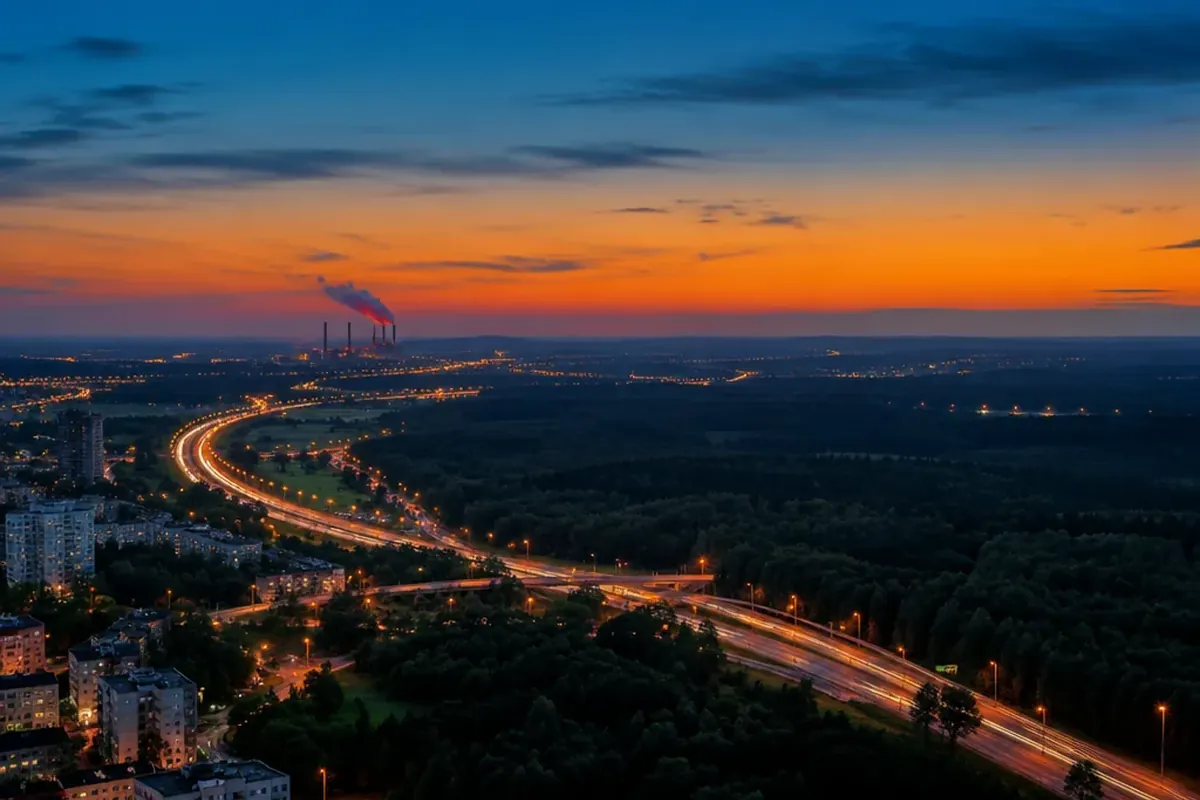
Anthropogenic means caused or produced by humans. The word is especially useful when a change in the environment has a human connection, whether people caused it directly or influenced it indirectly. It can describe a smokestack’s emissions, a drained wetland, a bright city sky, or a planet-scale shift in climate. The label does not mean that natural processes have stopped; it helps separate the human part of a change from the natural part.
What “anthropogenic” means in plain English
Anthropogenic is an adjective: it describes something that originates with people. The term was first recorded in English in 1847. Its roots combine the Greek anthropos, meaning human being, with -genic, relating to creation or production.
Common alternatives are man-made, human-caused, human-induced, human-made, anthropic, and synthetic. They are not always interchangeable in tone or precision. “Human-caused,” for example, clearly identifies responsibility, while “synthetic” can describe a material without explaining its environmental effect.
Everyday anthropogenic examples make the idea visible
Human influence is not limited to carbon emissions. It appears wherever sustained human activities alter land, water, air, light, or sound.
| Human activity or output | What the figures show | Environmental connection |
|---|---|---|
| Energy use | Energy-related CO2 emissions reached 37.8 Gt in 2024. | Combustion adds carbon dioxide to the atmosphere. |
| Plastic production | Production grew from 2 million tonnes in 1950 to 460 million tonnes in 2019. | Between 1 and 2 million tonnes of plastic enter the oceans each year. |
| Shipping noise | Noise from shipping lanes can reach 190 decibels underwater. | It can affect marine animals’ communication, navigation, and predator detection. |
| Artificial light | More than 80% of the world’s population lives under sky glow. | Light can disrupt animals that navigate by moonlight, including sea turtles and birds. |
Land conversion is another clear example. Anthromes, or anthropogenic biomes, map ecological patterns formed through ongoing interactions between people and ecosystems. Of 21 anthrome classes, only three are classified as wild biomes: remote forests, ice, and tundra. The rest describe land that has been transformed or managed by people in lasting ways.
Why anthropogenic climate change differs from natural climate change
Anthropogenic climate change is climate change caused or influenced by human activity, superimposed on natural climate cycles. Earth’s orbit, solar output, ocean cycles, and volcanic activity can all affect climate.
Carbon dioxide emissions show the contrast clearly. Human activities emit 60 or more times as much CO2 each year as all volcanoes combined. In 2015, people emitted roughly 40 billion metric tons of CO2, while volcanoes worldwide emitted less than 1 billion. Atmospheric CO2 reached 422.8 parts per million in 2024, about 50% higher than before the Industrial Revolution. Over the past 60 years, its annual rate of increase has been about 100 times faster than natural increases at the end of the last ice age.
The IPCC’s 2023 synthesis report estimated human-induced warming at 1.19 C above 1850–1900 for the 2014–2023 decade average. Over the last 650,000 years, Earth experienced about seven ice ages, but recent warming since 1950 cannot be explained by natural cycles alone.
Wetlands show how human activities reshape living systems
Since 1970, approximately 411 million hectares of wetlands—22% of the global total—have been lost. They continue to decline by 0.52% a year, and around one-quarter of those remaining are in poor ecological condition.
A major route is conversion to cropland. A 2022 estimate put global inland-wetland loss since 1700 at 3.4 million square kilometers, a 21% net loss. The consequences matter because wetlands contain 40% of all plant and animal species and are disappearing three times faster than forests.
The Anthropocene is useful even without formal epoch status
The Anthropocene is an informal term for an era in which humans act as a planetary force. Diatom researcher Eugene F. Stoermer coined it informally in the 1980s, and atmospheric chemist Paul J. Crutzen popularized it in 2000. It is often connected to the Great Acceleration: rapid changes in human-environment relationships beginning in the 1950s across 12 socioeconomic and Earth-system indicators.
The term has not become a formal geological epoch. In March 2024, the International Commission on Stratigraphy rejected a formal proposal after 15 years of deliberation. The proposed boundary was around 1952, marked at Crawford Lake in Ontario by a plutonium spike from hydrogen-bomb tests. Formal status aside, Earth-system science still uses the concept to describe the scale of human influence.
Common misunderstandings hide the human signal
“Natural climate change means people cannot change climate.”
Natural climate change is real. So are measurable human additions to the atmosphere. The question is not whether nature varies; it is whether human activity contributes to the observed change.
“Anthropogenic only means pollution.”
The term is broader. It includes greenhouse-gas emissions and plastic waste, but it can also describe artificial light, underwater noise, land conversion, and ecological patterns shaped through long-term management.
“A human effect must be intentional.”
No. Environmental change can be anthropogenic when it is an indirect result of human actions. The word describes origin or influence, not motive.
Frequently Asked Questions
What does the term “anthropogenic” mean?
It means caused or produced by humans. In environmental contexts, it can include changes people cause directly or influence indirectly.
What is another word for “anthropogenic”?
Depending on the context, use man-made, human-caused, human-induced, human-made, anthropic, or synthetic. “Human-caused” is often the clearest choice for environmental effects.
What are some examples of anthropogenic activity?
Burning fossil fuels for energy, producing plastic, converting wetlands to cropland, creating artificial light, and shipping that generates underwater noise are all examples.
What is anthropogenic climate change?
It is the human contribution to climate change. The IPCC estimated human-induced warming at 1.19 C above 1850–1900 for the 2014–2023 average.
How do human activities affect wetlands?
Conversion to cropland is a major driver of loss. Since 1970, about 411 million hectares of wetlands have disappeared, while many remaining wetlands are in poor ecological condition.
What is the Anthropocene?
It is an informal name for a time in which humans act as a planetary force. Scientists proposed a start around 1952, but in March 2024 the International Commission on Stratigraphy rejected making it a formal geological epoch.
Is anthropogenic climate change real?
Yes. Human activities emit 60 or more times as much CO2 each year as all volcanoes combined, and the IPCC attributes about 1.19 C of warming to human influence. Warming since 1950 cannot be explained by natural cycles alone.
Sustainable development meets the needs of the present without compromising the ability of future generations to meet their own.