
What is the tragedy of the commons? Hardin’s idea, real examples from cod to CO2, Elinor Ostrom’s 8 design principles, and solutions that work.
National Councils for Sustainable Development
The Phosphorus Cycle: Steps, Human Impact and Why It Matters
What Is Ecotourism? Principles, Examples, Greenwashing
What is ecotourism? Learn its 8 core principles, real examples from Costa Rica to Palau, its downsides, and how to spot greenwashing before you book.
Solarpunk: The Hopeful Vision of a Sustainable Future
What is solarpunk? Origins, core ideas, architecture, solarpunk vs. cyberpunk, real-world projects, criticisms, and how you can help build it.
Anthropogenic: Meaning, Examples and Effects on the Planet
Learn what anthropogenic means, how human activities affect climate and wetlands, and why the term matters for understanding planetary change.
Regional sustainable development networks: Africa, Asia-Pacific, the Americas and Europe
Sustainable development work is organised by region as much as by country. An overview of the regional bodies and where their reports can be found today.
National Councils for Sustainable Development: what they were and what replaced them
How the national councils that grew out of the 1992 Earth Summit worked, why the global network faded, and where that work continues today.
Agenda 21, Chapter 18: protecting freshwater resources
Chapter 18 of Agenda 21 set out the first global programme for freshwater management. Here is what it asked for and how the water agenda looks today.
WSSD – World Summit for Sustainable Development
The World Summit for Sustainable Development (WSSD) refers to a summit that occurred in Johannesburg in the last week of August and first week of September 2002. It
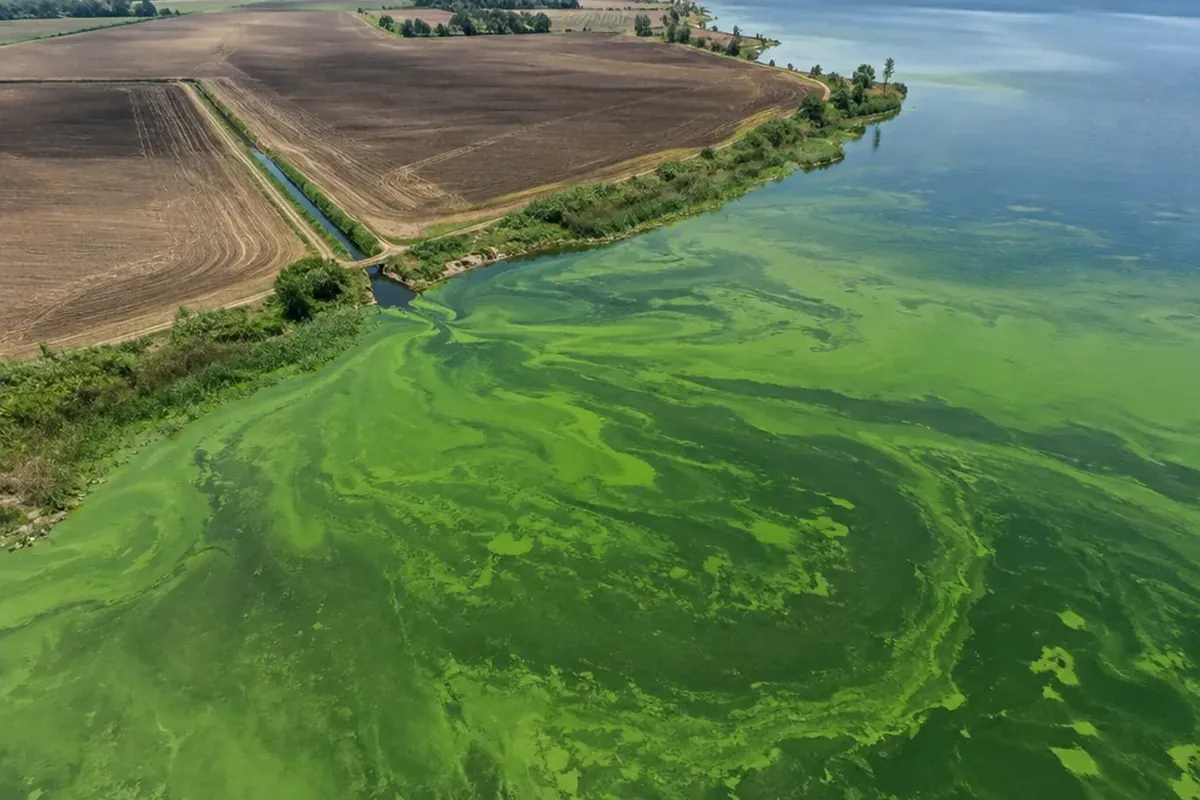
The phosphorus cycle is the slow movement of phosphorus, mainly as phosphate, from rock to soil, water, living things, and ocean sediment, and back to rock. Unlike the carbon and nitrogen cycles, it has no major atmospheric phase. It matters because phosphorus helps build DNA, RNA, ATP, cell membranes, bones, and teeth, and because too much of it in water feeds algal blooms and dead zones.
What phosphorus is and why every organism needs it
With atomic number 15, phosphorus (P) is highly reactive and therefore does not occur as a free element in nature. Instead, it exists almost entirely as phosphate (PO43-) in minerals and living tissue. In DNA and RNA, phosphate groups form the sugar-phosphate backbone. ATP, the molecule that powers most cellular work, contains three phosphate groups. Cell membranes get their structure from phospholipids.
In the human body, bones and teeth store about 85% of phosphorus as calcium phosphate. Another 14% is inside cells, and only 1% circulates in blood serum. Across plants, animals, and microorganisms, phosphorus serves as both a structural material and an energy-transfer ingredient.
Why the phosphorus cycle moves differently from carbon and nitrogen
Biogeochemical cycles fall into three types: hydrological, gaseous, and sedimentary. The water cycle is hydrological. Because they have major atmospheric reservoirs, the carbon cycle, nitrogen cycle, and oxygen cycle are gaseous. By contrast, phosphorus and sulfur are sedimentary cycles, tied primarily to rocks, soils, water, and sediment.
Under normal environmental conditions, phosphorus does not form stable gases as carbon and nitrogen do. Windblown dust carries a small amount, but that flux is negligible beside atmospheric carbon or nitrogen. As a result, the movement of phosphorus is mostly local: weathering, erosion, runoff, and water transport. Its fast biological loop runs over years to decades, while burial in ocean sediment can delay its geological return for millions of years.
The seven steps that move phosphate from rock to life and back
- Weathering. Rain, temperature changes, and chemical reactions break down phosphate-bearing minerals, especially apatite. This releases dissolved phosphate ions into soil and water.
- Plant uptake. From soil solution, roots absorb dissolved inorganic phosphate and use it in organic molecules including DNA, RNA, and ATP.
- Consumption. Animals get phosphorus by eating plants or other animals. It becomes part of their bones, teeth, and cells.
- Decomposition. After organisms die or leave waste, bacteria and fungi break down the organic matter. This process, called mineralization, returns phosphate to the soil.
- Runoff and transport. When plants do not take it up, phosphate can leave soil for streams, lakes, and the ocean.
- Sedimentation. In the ocean, calcium can combine with phosphate as insoluble calcium phosphates; these settle on the ocean floor and become buried under accumulating sediment.
- Uplift. Eventually, tectonic movement raises phosphate-bearing sedimentary rock to land, where weathering begins the cycle again. This step takes tens to hundreds of millions of years.
Where phosphorus is stored and why availability is the bottleneck
Sedimentary phosphate rock, mostly apatite, is the largest reservoir. Ocean sediments are the second largest and act as a long-term sink. By contrast, soil holds a small but biologically decisive reservoir: only the tiny fraction of phosphate dissolved in soil solution is directly available to roots. In freshwater, trace amounts of dissolved phosphate help explain why phosphorus often limits growth in lakes and rivers.
| Reservoir | Role in the cycle |
|---|---|
| Phosphate rock | Largest store and the sole natural source for terrestrial and aquatic ecosystems through weathering. |
| Soil solution | Small pool that plant roots can directly use. |
| Living biomass | Smallest reservoir, but phosphate moves rapidly through the food chain and decomposition. |
| Ocean sediment | Long-term sink that can retain phosphorus for millions of years. |
Soil chemistry limits uptake further. In acidic soils, phosphorus binds with aluminum and iron; in alkaline soils, it forms insoluble calcium phosphates. In either case, phosphorus may be present in soil but unavailable to plants.
How human activities speed up a naturally slow cycle
Mining moves phosphorus from geological reservoirs into farms and products far faster than natural weathering. In 2025, global phosphate rock production was about 250 million metric tons. Of the mined material, only about 5% goes to non-fertilizer products such as detergents, corrosion prevention, and food additives; fertilizer dominates demand. Morocco holds the largest phosphate rock reserves, about 50 billion metric tons or roughly 70% of the global total, while China is the largest producer.
Measured as P2O5, global fertilizer consumption was 47.8 million tons in 2025 and is projected to reach 51.5 million tons by 2029. That creates a difficult double challenge: agriculture depends on a finite geological resource, while phosphorus that escapes fields can overload an ecosystem downstream. One route back toward a circular system is wastewater recovery. Under optimized conditions, struvite crystallization can recover 80–90% of dissolved phosphorus from wastewater and turn it into a slow-release fertilizer.
Scientists track this pressure with a planetary boundary for phosphorus. The safe flow from fertilizers to the oceans is estimated at about 11 million metric tons of phosphorus a year; current flows are roughly double that, and the boundary is considered transgressed.
Why fertilizer runoff can turn lakes and coastal waters into dead zones
Although fertilizer supports crop growth, surplus nutrients can travel with surface runoff. On average, crops take up about 40% of nitrogen applied in a season; excess nitrogen and phosphorus can reach waterways. In freshwater, extra phosphate acts as fertilizer for algae, including cyanobacteria that may produce toxins dangerous to people and animals.
After an algal bloom dies, bacteria decompose it and consume dissolved oxygen. This low-oxygen result can kill fish and other aquatic life, a process called eutrophication. Lake Erie’s 2011 bloom, the largest on record, was linked to long-term agricultural phosphorus loading and reached a severity index of 10 out of 10. Farther south, nutrient-laden freshwater from the Mississippi and Atchafalaya Rivers forms the Gulf of Mexico Dead Zone each summer. In 2019, the zone covered nearly 7,000 square miles—roughly the size of New Jersey.
Common misunderstandings about this nutrient cycle
“Phosphorus circulates through the air like nitrogen.”
No. Phosphorus has no significant gaseous phase. Some phosphorus can move through the atmosphere as dust, but rock weathering, erosion, water, and sediment control the global phosphorus cycle.
“More phosphate always means healthier plant growth.”
Not necessarily. As a limiting nutrient, phosphorus constrains growth when it is scarce. But excess phosphate that plants do not absorb can enter water and feed harmful algal blooms instead.
“All phosphorus in soil is available to roots.”
No. Roots can directly use only dissolved inorganic phosphate in soil solution. Depending on soil pH, phosphorus can become locked into compounds with aluminum, iron, or calcium.
Frequently Asked Questions
What is the phosphorus cycle, and why is it important?
It is the movement of phosphorus among rocks, soil, water, organisms, and sediments. It supplies a nutrient needed for genetic material, energy transfer, membranes, and skeletal tissue, and it shapes plant growth and water quality.
What are the main sources and reservoirs of phosphorus?
Weathering of phosphate minerals is the sole natural source for terrestrial and aquatic ecosystems. Sedimentary phosphate rock is the largest reservoir, followed by ocean sediments; soil solution and living biomass are much smaller but biologically active pools.
Which parts of the cycle are geological processes?
Weathering, erosion and transport, sedimentation, burial, and tectonic uplift are geological processes. Together, they make the cycle far slower than gaseous nutrient cycles.
How do humans affect the phosphorus cycle?
Mining and fertilizer use move phosphorus rapidly from rock into fields and products. Runoff can carry excess phosphate into lakes and coastal waters, while wastewater recovery can return some phosphorus to agricultural soil.
What depletes the body of phosphorus?
Common causes of phosphate depletion include respiratory alkalosis, malnutrition, and use of diuretics or corticosteroids. In the United States, low dietary intake alone is extremely rare; severe hypophosphatemia requires medical care.
Sustainable development meets the needs of the present without compromising the ability of future generations to meet their own.